
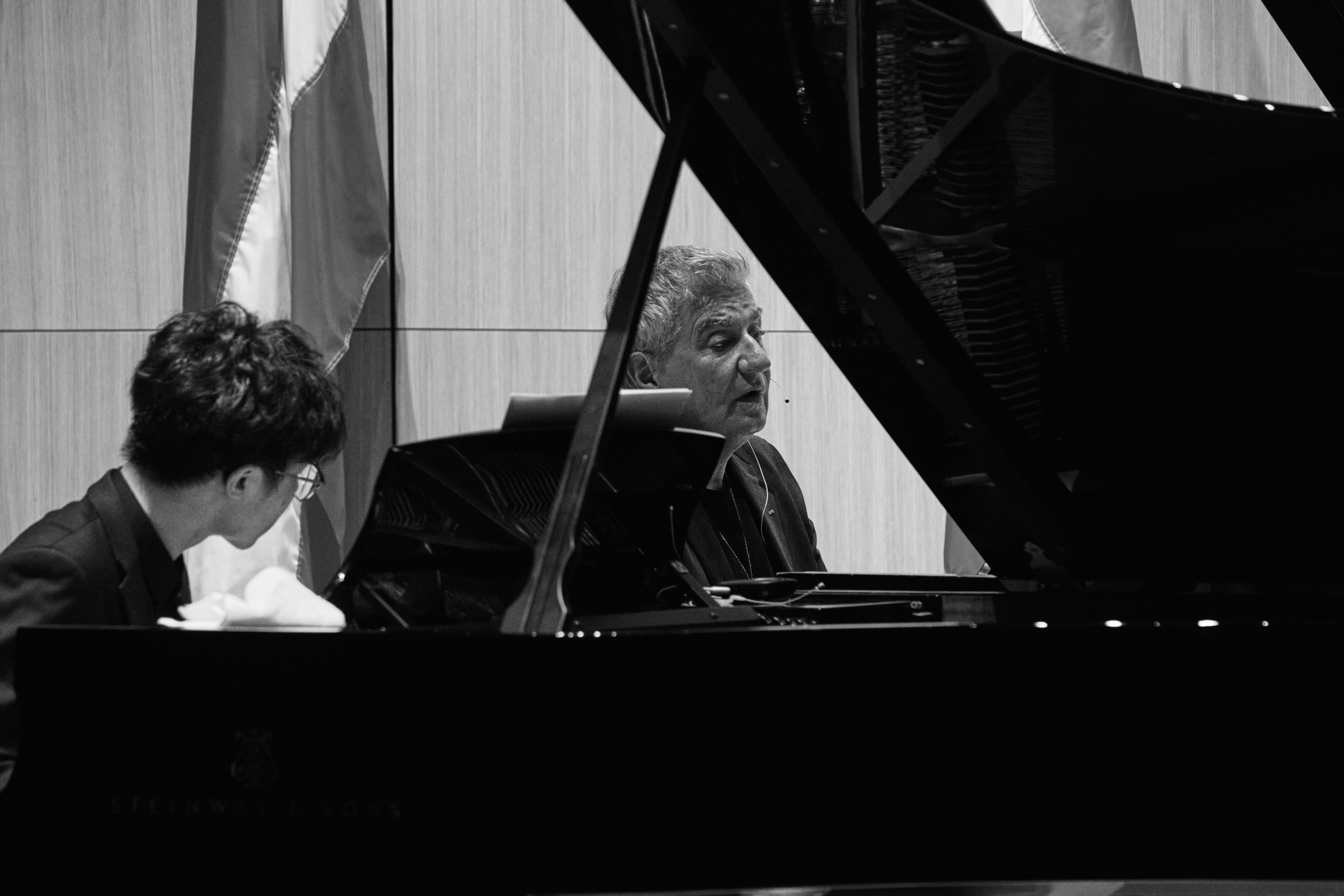
Senior Division contestant Chenxu Han with Jean-Yves Thibaudet.
Photography by Malcolm Henoch.
From afar, it seems effortless. A pianist walks onstage and plays a difficult piece with an elegant proficiency that makes it look easy. But the public rarely sees the hard, behind-the-scenes work that goes into learning a piece and preparing it for performance. That process was on vivid display in the Final Masterclass Round held on Wednesday, July 29 at the Cleveland Institute of Music.
Piano Cleveland broke new ground by integrating masterclasses as part of this year’s competition, with no less a luminary than virtuoso Jean-Yves Thibaudet advising six young performers. He was a gracious and attentive mentor, sitting in the audience to hear each contestant play a piece, taking the stage to work with them on refining it, then returning to his seat to hear a polished performance. Side-by-side Steinways allowed him to demonstrate his ideas as he guided each young artist through their piece literally bar by bar.
Thibaudet’s approach varied according to the skill levels. In the opening Junior Division round, he focused on improving basic technical expertise while encouraging the players to step back and consider the larger sonic possibilities of their instrument. In the advanced Senior Division round, it was more a matter of fine-tuning accomplished performances with an emphasis on expression and attention to details. Throughout both rounds, Thibaudet invoked orchestral analogies to broaden the players’ approach. “Think of this as a cello sound,” he would say about a particular passage – or flutes or horns or violins or whatever instrument facilitated a more colorful interpretation.
Canadian/American Ryan Huang, 15, opened the Junior Division session with a light, lyrical treatment of Reflects dans l’eau from Book 1 of Debussy’s Images. The piece gave Huang an opportunity to show his versatility, though perhaps too much so, as Thibaudet said he found the opening and closing of his interpretation “too complicated.” In working to simplify it, he focused both on specifics and the overall structure. “You can treat this like a cadenza,” he said of one passage, encouraging a less formal approach. Thibaudet also spent a lot of time on dynamics, in particular how Huang uses the pedals. Though the changes were subtle when he played the piece again, the broader dynamic range was clear and convincing.
South Korean Jueon Lee, 14, seemed a bit overwhelmed by the physical demands of the Ondine from Ravel’s Gaspard de la nuit. Thibaudet wanted to hear more energy and flair, especially in the crescendos, which he demonstrated with fiery authority while encouraging Lee to “imagine the sound of a huge orchestra.” Technically, he worked with the young player on his use of the pedals, tempo and phrasing – for the latter, focusing on how Lee used just his left or right hand, and suggesting the primary voice could belong to either. It was one of the longest advice sessions, with Thibaudet both playing and singing what he wanted to hear. That could have been intimidating, but Lee showed himself to be an adept student, playing a deeper, more nuanced version the second time.
The Junior session concluded with an impressive performance of Scriabin’s Sonata No. 4 by China’s Yixin Chen. At the tender age of 15, Chen already has her own voice, which she showed in a tightly controlled, distinctive interpretation. “I think you can do more to enjoy yourself,” Thibaudet told her when he took the stage, demonstrating a more luxurious approach to some passages and offering advice like, “That could be done in a dreamy way – very dreamy.” There was some technical work on the downbeat and syncopation, but mostly Thibaudet encouraged stylistic refinements with comments like “much better” and “very beautiful.” Playing the piece again, Chen showed a fine ability to incorporate his suggestions into her own personal style.
To kick off the Senior session, 17-year-old Chenxu Han, also from China, offered an intense version of Liszt’s Mephisto Waltz No. 1. Playing with his nose almost touching the keyboard, he imbued the piece with drama and large dimensions. “You have absolutely incredible control,” Thibaudet told him, “but I think you can take risks. Let yourself go.” He worked with Han on rhythms that had both of them bouncing on their benches, as well as adding color to passages that he found “dry” and giving the conclusion more of a melodic flow. The refinements in approach were all in service of reinforcing what Thibaudet called the “excitement and adrenalin” in Han’s playing, which came to the fore in a more spirited second version of the waltz, drawing a hearty “Bravo!” from his instructor.
Spain’s Guillermo Hernández Barrocal showed remarkable poise for an 18-year-old and a ton of technique in his performance of the Allegro from Brahms’ Sonata No. 1. While his playing was sophisticated, it was also a bit stiff. Thibaudet encouraged him to open up his approach both rhythmically and stylistically, and was very specific about the sounds he wanted to hear – like a cello at one point, and horns at another, con sordino no less. He also offered technique tips like using arm weight to keep the sound inside the keys. Barrocal absorbed it all so well that he was the only contestant who did not review the score before playing the piece again, this time with more character and color.
It would be unfair to say that the program saved the best for last, but South Korea’s Yurim Kim, 17, seemed ready for the professional stage with a riveting performance of the Allegro from Schumann’s Faschingsschwank aus Wien. Kim is one of those players who feels the music, which seems to flow from her hands with instinctive facility and ringing command. “Very nice,” Thibaudet said when he joined her, “but I think you need to have a little more fun.” Rhythms with more bounce brightened the music, with Thibaudet standing up and stomping around a bit to demonstrate what he had in mind. His advice had immediate effect. While still dramatic, the piece was livelier, even joyful the second time, with a lilt that reflected both intelligence and grace.
Now in his sixth decade as a professional performer, Thibaudet is the rare pianist whose work and influence extends well beyond the keyboard. He’s also been active in the fields of fashion, film, visual art and philanthropy, and consistently creative, as in his multimedia performances of Scriabin’s Prometheus: The Poem of Fire accompanied by a light show and scents from Cartier. And he cuts an original figure, in this appearance sporting shiny silver sneakers.
As a pedagogue Thibaudet showed himself to be both demanding and supportive, offering constant encouragement while holding his young charges to strict standards. He’s also quite demonstrative, singing to set a tempo, waving his arms to emphasize a point, mirroring a player’s body language. His enthusiasm for the music is unmistakable and infectious, as this group of players showed in the caliber of their performances under his guidance.
Given the talent those players showed, it’s no exaggeration to say that Thibaudet helped launch some promising young careers from the Cleveland Institute of Music stage this year. Every aspiring musician should be so lucky.
—Frank Kuznik
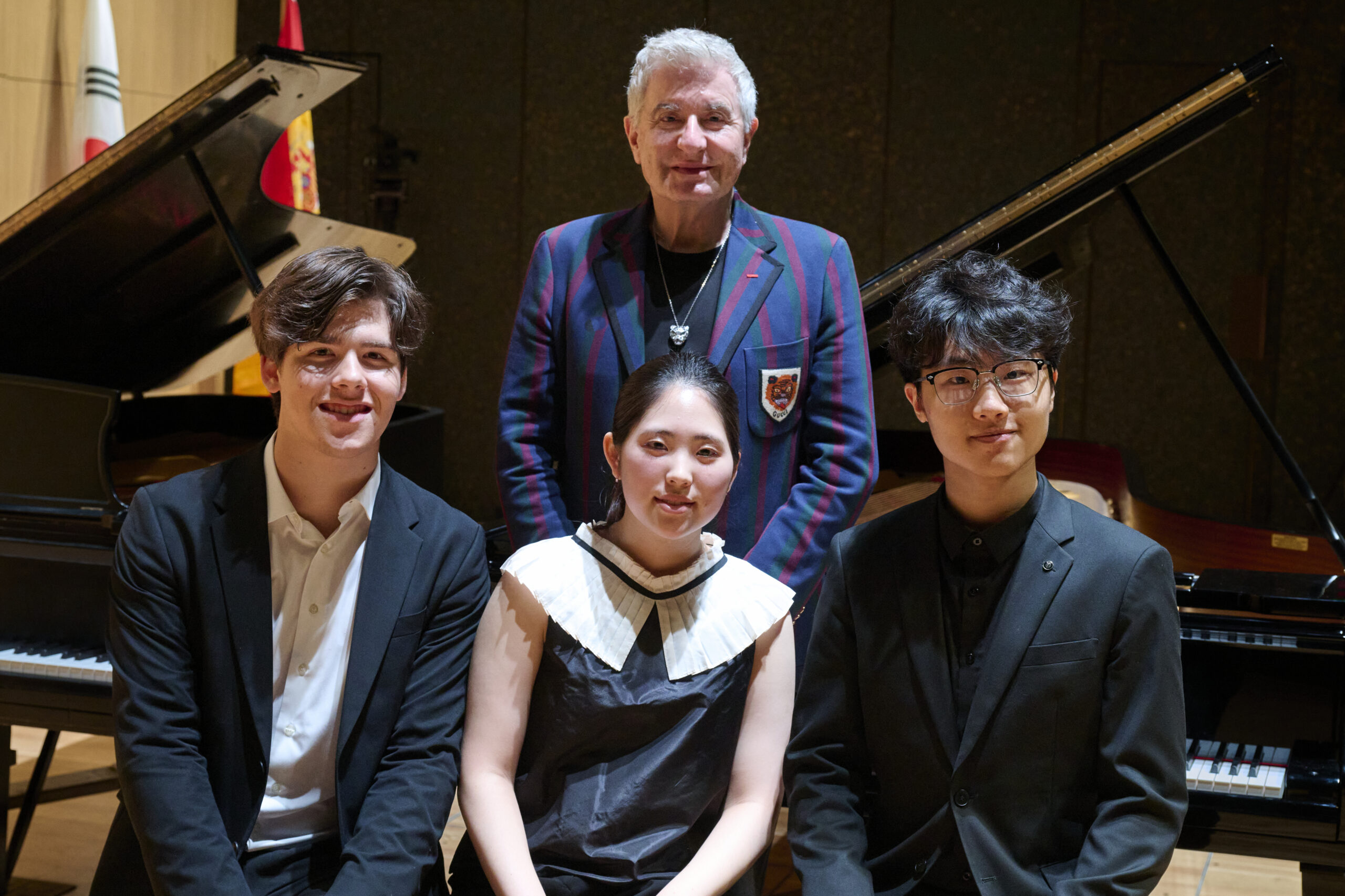
Jean-Yves Thibaudet (back center) with Senior Division contestants Guillermo Hernández Barrocal, Yurim Kim, and Chenxu Han (left to right).